
The Paradox of Modern Tap Water: Why "Safe" Doesn’t Mean "Healthy
If you live in a city, you likely trust that the water flowing from your tap is safe. After all, it looks clear, smells (mostly) fine, and the city government assures you it meets all federal regulations. And strictly speaking, they are telling the truth: your water is "safe." It will not give you cholera, typhoid, or dysentery today.
But there is a critical distinction that every family in Daytona needs to understand: Water that is "safe" by legal standards is not necessarily "healthy" for the human body.
While municipal treatment plants do an excellent job of killing bacteria using chlorine, that very process creates a new, insidious problem. When chlorine reacts with the natural organic matter found in our water sources (like leaves, soil, and algae—common in Florida surface waters), it creates toxic chemical compounds known as Disinfection Byproducts (DBPs).
The two most dangerous groups of these byproducts are Trihalomethanes (THMs) and Haloacetic Acids (specifically HAA5s and HAA9s).
These chemicals are invisible, tasteless, and odorless, yet they are present in nearly every drop of city-treated water. And unlike the bacteria they replaced, their damage isn't immediate—it is cumulative, silent, and potentially devastating.
What Are THMs and HAA9s?
To understand the threat, we have to look at the chemistry of our water treatment.
Trihalomethanes (THMs) are a group of four chemicals formed along with other disinfection byproducts. The most common one is chloroform—yes, the same chemical once used as an anesthetic. The EPA regulates these as "Total Trihalomethanes" (TTHMs), setting a legal limit of 80 parts per billion (ppb).
Haloacetic Acids (HAAs) are the second most common group of byproducts. The EPA currently regulates a group of five of them, known as HAA5. However, there are actually nine common haloacetic acids found in chlorinated water, collectively called HAA9.
Here is where the regulation gap lies: While the government monitors HAA5, the other four unregulated acids (which make up the rest of the HAA9 group) are often more toxic than the regulated ones. By focusing only on the "legal 5," many water reports mask the true toxicity of the water entering your home.
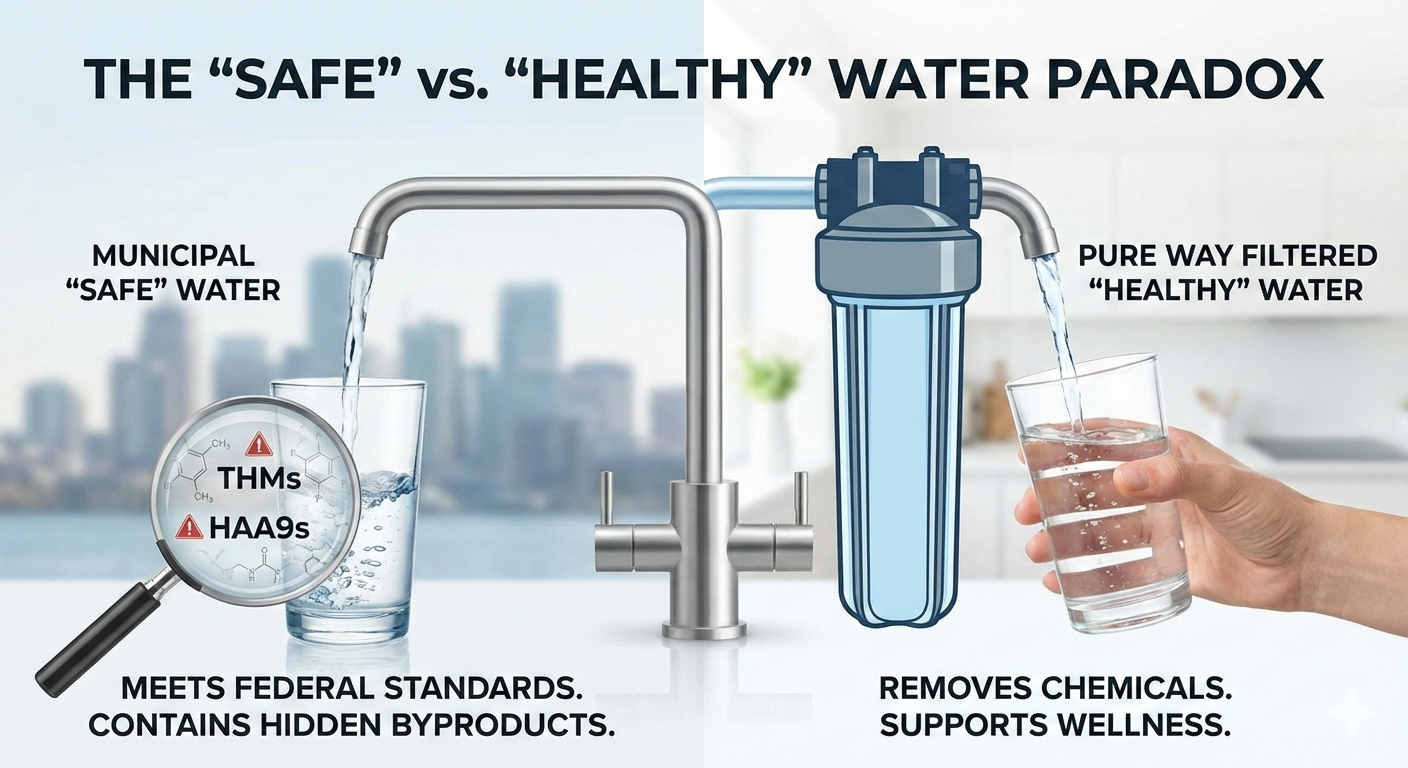
Why does the EPA allow these chemicals in our water if they are toxic? It comes down to a calculated risk. The government’s primary job is to prevent acute disease outbreaks. Chlorine is the cheapest and most effective way to stop mass illness from bacteria. The EPA accepts a "permissible risk" of cancer and chronic disease from these chemicals because the alternative (deadly bacterial outbreaks) is considered worse.
The "Safe" vs. "Healthy" Trap
Why does the EPA allow these chemicals in our water if they are toxic? It comes down to a calculated risk.
The government’s primary job is to prevent acute disease outbreaks. Chlorine is the cheapest and most effective way to stop mass illness from bacteria. The EPA accepts a "permissible risk" of cancer and chronic disease from these chemicals because the alternative (deadly bacterial outbreaks) is considered worse.
"Safe" simply means the water meets a compromise standard where the risk of dying from a waterborne virus is zero, and the risk of developing cancer over 70 years is kept "low enough" for government statistics.
"Healthy," however, means water that nourishes your cells, aids in detoxification, and adds nothing harmful to your body. City water containing THMs and HAAs fails this test completely.
The Massive Health Dangers Hidden in Your Pipes
The health risks associated with long-term exposure to THMs and HAAs are well-documented by scientific studies, yet rarely discussed in public water reports.
1. Carcinogenic Risks
Both THMs and HAA9s are classified as possible or probable human carcinogens. The most consistent link found in epidemiological studies is bladder cancer. Research suggests that long-term consumption of chlorinated tap water can significantly increase the risk of bladder cancer. There are also concerning links to rectal and colon cancers. The body struggles to filter these synthetic chemicals, leading to cellular damage over decades of consumption.
2. Reproductive Issues
Perhaps the most alarming risks are those posed to pregnant women and developing babies. High levels of THMs and HAA9s have been linked to adverse reproductive outcomes, including:
Spontaneous miscarriages
Low birth weights
Neural tube defects
Fetal growth restriction
For a family expecting a child, the "acceptable risk" defined by federal regulators is often not acceptable at all.
3. Organ Damage
Because the liver and kidneys are the body's filtration systems, they take the brunt of the damage when we ingest chemical contaminants. Chronic exposure to haloacetic acids has been linked to liver inflammation, kidney damage, and nervous system issues in animal studies.
The Shower Threat: It’s Not Just What You Drink
Most people assume that if they buy a pitcher filter or drink bottled water, they are safe. This is a dangerous misconception.
In strict terms of THM exposure, your morning shower may be more dangerous than the water you drink.
THMs are highly volatile, meaning they evaporate easily. When you take a hot, steamy shower, these chemicals vaporize into the air. You then inhale them directly into your lungs.
Inhalation: When inhaled, these chemicals bypass the liver (your body’s primary defense filter) and go directly into the bloodstream.
Dermal Absorption: Your skin is a porous organ. Warm water opens your pores, allowing THMs and HAAs to be absorbed directly into your body.
A 10-minute shower can result in greater absorption of chlorine byproducts than drinking a gallon of the same tap water. If you can smell the chlorine in your shower, you are essentially inhaling a gas chamber of disinfection byproducts.
The Florida Factor: Why Daytona is at Risk
In Florida, our water challenges are unique. Our source water is often rich in organic matter—tannins from decaying vegetation in our rivers and lakes.
The more organic matter in the water, the more chlorine the city must add to disinfect it. The more chlorine they add, the more it reacts with that organic matter to form higher levels of THMs and HAA9s.
During the hotter months, when algae blooms and organic content rise, the levels of these cancer-causing chemicals can spike. While the city tries to manage this, they are fighting a losing battle against chemistry. They must chlorinate to kill bacteria, which means they must create these toxins.
The Solution: Take Control of Your Water
We cannot rely on the city to provide healthy water; their mandate is only to provide sanitized water. The bridge between "safe" and "healthy" must be built in your own home.
At Pure Way of Daytona, we believe you shouldn't have to choose between bacteria-free water and chemical-free water. You can—and should—have both.
The Power of Whole-Home Filtration
To truly protect your family from THMs and HAA9s, you need to address every point of entry—not just the kitchen sink. A Whole-Home Water Refiner or filtration system ensures that:
Bathing is Safe: You can shower without inhaling carcinogenic chloroform gas.
Skin is Protected: You avoid absorbing HAAs through your pores.
Appliances Last Longer: Removing these harsh chemicals prevents corrosion in your plumbing.
Advanced Drinking Water Systems
For the water you consume, a standard carbon filter isn't enough. Advanced systems, like Reverse Osmosis (RO)combined with high-quality carbon block filtration, are the gold standard.
Carbon Filtration is highly effective at adsorbing THMs and HAAs, trapping them in the filter media so they never reach your glass.
Reverse Osmosis acts as the final barrier, removing dissolved solids, heavy metals, and any remaining chemical residues.
Conclusion: Your Health is Your Responsibility
The "safe but not healthy" paradox is the reality of modern city living. The city is doing its job by preventing waterborne disease, but the unintended consequences of that process act like a slow poison.
You have the power to change the quality of life for your household. By removing THMs, HAA9s, and chlorine from your water, you aren't just improving the taste—you are removing a daily chemical assault on your body’s cells.
Don't settle for water that meets the government's "minimum standards." Aim for water that meets your standards for health and longevity.