
The Invisible Guest: What Drinking Microplastics Really Does to Your Body
It’s a startling statistic: some studies suggest the average adult may ingest the equivalent of a credit card’s worth of plastic every single week. While we often think of plastic pollution as an "ocean problem," it has officially become an "us problem."
Microplastics—tiny particles less than 5mm in size—have been detected in everything from bottled water to the remote reaches of our own internal organs. But what happens once they're inside? Using the latest research and anatomical insights, let’s break down the potential impact of drinking these invisible invaders.
A System-by-System Look at the Risks
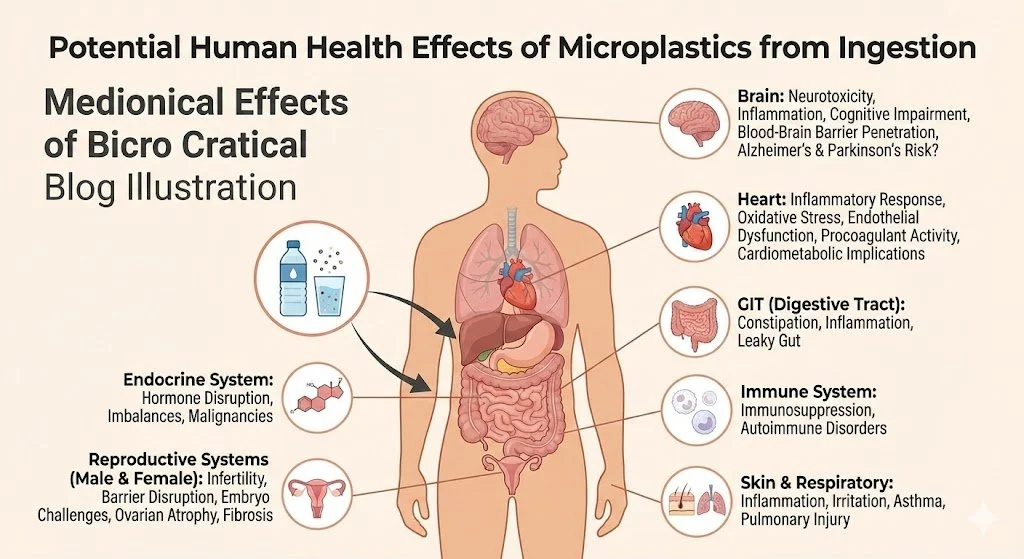
According to current medical illustrations and emerging 2026 research, microplastics aren't just passing through; they may be interacting with almost every major system in the human body.
1. The Brain & Nervous System
Perhaps the most concerning discovery is that nanoplastics (even smaller versions of microplastics) can penetrate the blood-brain barrier.
Neurotoxicity & Inflammation: Once in the brain, they may trigger inflammatory responses.
Cognitive Impact: There are growing concerns regarding links to cognitive impairment and neurodegenerative conditions like Alzheimer’s and Parkinson’s.
2. The Digestive Tract (GIT)
Since drinking is a primary route of entry, the Gastrointestinal Tract is the "front line."
Leaky Gut: Microplastics can damage the intestinal lining, leading to increased permeability.
Microbiome Disruption: They may alter the balance of healthy bacteria in your gut, leading to chronic inflammation or constipation.
3. Cardiovascular Health
Recent studies have found microplastics embedded in human heart tissue and arterial plaques.
Heart Stress: Their presence is linked to oxidative stress and "procoagulant activity" (increased risk of blood clots).
Increased Risk: Patients with microplastics in their arteries have been shown to have a higher risk of heart attack and stroke.
4. Reproductive & Endocrine Systems
Microplastics often act as "Trojan Horses" for chemicals like BPA and phthalates.
Hormonal Imbalance: These particles function as endocrine-disrupting compounds, mimicking or blocking natural hormones.
Fertility Issues: In both the male and female reproductive systems, microplastics are linked to infertility, embryo challenges, and organ-specific damage like ovarian atrophy or blood-testis barrier disruption.
Bottle water
Can contain up to 240,000 plastic particles per liter.
How to Reduce Your Intake
While it is nearly impossible to avoid microplastics entirely in 2026, you can significantly lower your "dose" with a few habit shifts:
Ditch the Plastic Bottle: Switch to glass or stainless steel. Disposable plastic bottles degrade quickly, especially when exposed to heat or sunlight.
Use High-Quality Filtration: Look for carbon block or reverse osmosis filters certified to remove "particulates" down to the sub-micron level.
Avoid "Single-Use" Heat: Never microwave food or water in plastic containers, as heat accelerates the shedding of millions of particles.
The Bottom Line: While science is still mapping the full long-term effects, the "physical" presence of plastic in our tissues and the "chemical" leaching of additives present a clear reason to be cautious.