
The Invisible Threat: Understanding Toxic Contaminants in Our Water and How to Protect Your Family
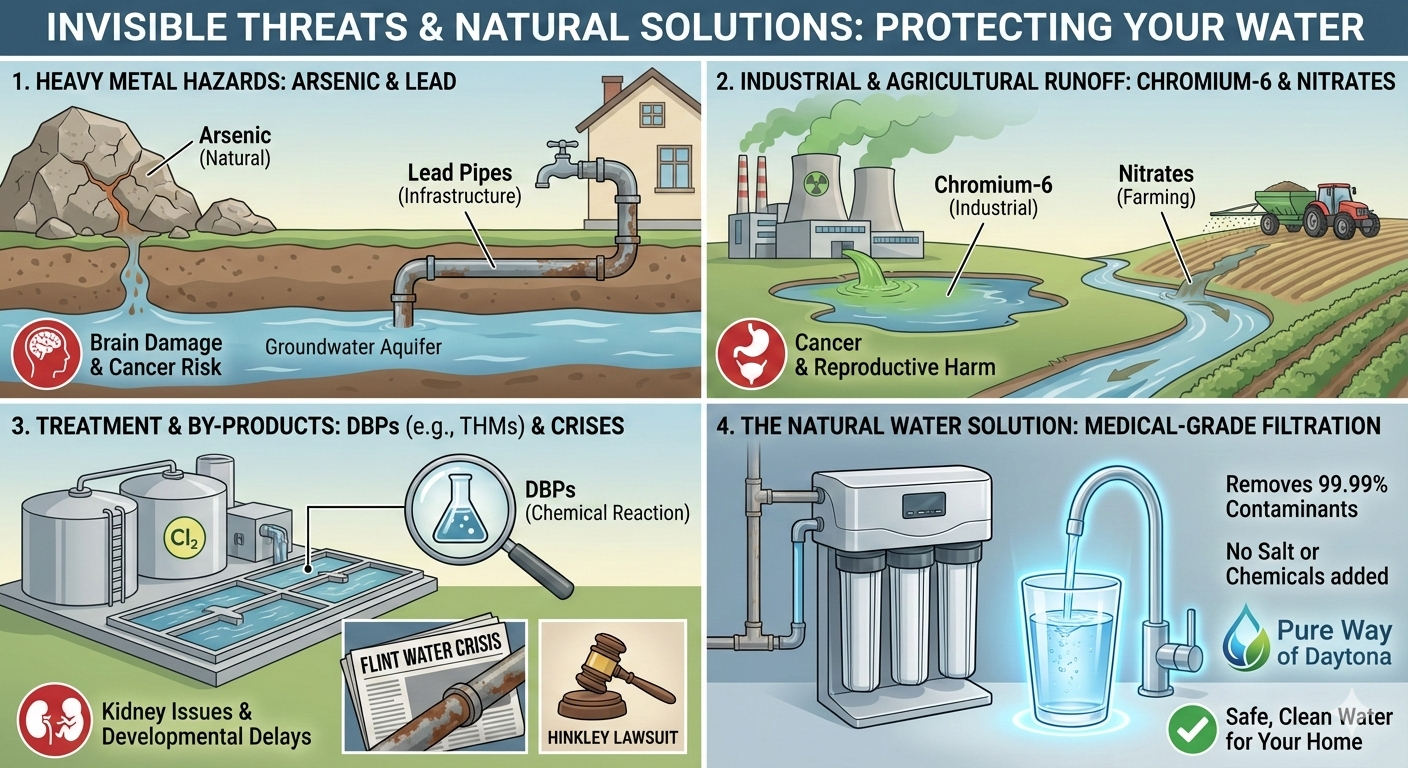
Water is the essence of life, yet for millions of Americans, the liquid flowing from their taps carries invisible dangers.
While the United States generally has some of the safest drinking water in the world, aging infrastructure, industrial legacy, and agricultural runoff have left indelible marks on our water supply.
From the rust belt of Michigan to the desert towns of California, the stories of water contamination are not just history—they are ongoing public health battles.
Understanding the specific threats posed by Arsenic, Lead, Chromium-6, Disinfection By-products, and Nitrates is the first step toward safeguarding your health. Moreover, as we uncover the severity of these toxins, the move toward "natural water solutions"—advanced filtration that removes contaminants without adding chemicals or salt—has become a vital frontier in home health.
1. Arsenic: The Silent Carcinogen
Arsenic is a naturally occurring element found in the earth’s crust, but its presence in drinking water is a severe public health hazard. It is tasteless and odorless, making it impossible to detect without testing.
According to the World Health Organization (WHO), arsenic is a "highly toxic" substance in its inorganic form. The health implications of long-term exposure are devastating. The WHO states that long-term ingestion of arsenic-contaminated water is a confirmed cause of skin, bladder, and lung cancer. Beyond cancer, it is linked to cardiovascular disease and diabetes.
Perhaps most concerning are the effects on the next generation. Exposure in utero and during early childhood has been linked to negative impacts on cognitive development, including intelligence and memory deficits. The toxicity is cumulative, meaning the effects occur after a minimum exposure period, often surfacing years after the water was consumed.
Source: World Health Organization - Arsenic Key Facts
2. Lead: A Legacy of irreversible Damage
Lead is rarely naturally present in source water; it enters drinking water primarily through the corrosion of plumbing materials. It is a potent neurotoxin with no safe level of exposure for children.
The Health Risks For children and pregnant women, lead is catastrophic. In children, even low levels of exposure have been linked to damage to the central and peripheral nervous system, learning disabilities, shorter stature, impaired hearing, and impaired formation and function of blood cells. For pregnant women, lead accumulates in the bones and is released during pregnancy, leading to miscarriage, premature birth, and developmental delays in the fetus.
The Flint, Michigan Crisis The dangers of lead were thrust into the national spotlight in 2014 during the tragedy in Flint, Michigan. In a cost-saving move, the city switched its water source from the treated Detroit Water and Sewerage Department water to the Flint River. Officials failed to add corrosion inhibitors, causing the highly corrosive river water to eat away at the city's aging lead pipes.
The result was a public health disaster. Thousands of children were exposed to dangerous levels of lead. Reports indicated that fertility rates in Flint dropped by 12%, and fetal death rates rose by 58% following the switch. The crisis served as a grim wake-up call that regulations alone do not guarantee safety; infrastructure and proper treatment are the only true safeguards.
3. Chromium-6: The "Erin Brockovich" Chemical
Chromium-6 (Hexavalent Chromium) is a heavy metal often used in industrial processes like chrome plating and cooling tower treatment. Unlike its nutritional cousin Chromium-3, Chromium-6 is a known carcinogen.
Hinkley, California The world learned about Chromium-6 through the town of Hinkley, California. In the 1950s and 60s, Pacific Gas & Electric (PG&E) used Chromium-6 to fight corrosion in cooling towers and dumped the wastewater into unlined ponds. The chemical seeped into the groundwater, turning the water in Hinkley into a toxic cocktail.
Legal clerk Erin Brockovich investigated the illness clusters in the town, finding links to everything from nosebleeds to severe cancers. Her work led to a massive class-action lawsuit settled in 1996 for $333 million. However, the story didn't end there; the plume of contamination in Hinkley has continued to spread in the years since, serving as a reminder of the persistence of this metal in groundwater.
Widespread Presence While Hinkley is the most famous case, Chromium-6 is not an isolated incident. A 2016 report by the Environmental Working Group (EWG) found that Chromium-6 contaminates the tap water of more than 200 million Americans. Because federal regulations for chromium are often outdated (grouping toxic Chromium-6 with benign Chromium-3), many water systems are legally compliant while still containing levels of this carcinogen that scientists deem unsafe.
4. Disinfection By-products (DBPs): The Consequence of Cleaning
It is a cruel irony that the chemicals used to make our water safe from bacteria can create new dangers. Disinfection By-products (DBPs), such as Trihalomethanes (THMs), are formed when chlorine—used universally to disinfect public water—reacts with natural organic matter (like decaying leaves) in the water.
Health Risks While chlorine kills pathogens like E. coli, the resulting DBPs are toxic. Studies have consistently linked long-term exposure to THMs with an increased risk of bladder cancer. There is also evidence associating DBPs with kidney issues and reproductive problems, including increased risks of miscarriage and birth defects. This presents a complex challenge for municipal water treatment: how to kill bacteria without poisoning the consumer with chemical by-products.
5. Nitrates: The Agricultural Runoff
Nitrates are chemical compounds composed of nitrogen and oxygen. While nitrogen is essential for plant growth, excess nitrates in drinking water are dangerous. This is a primary concern in agricultural areas where fertilizer runoff and animal manure seep into groundwater aquifers.
Health Risks The most acute risk of nitrates is "Blue Baby Syndrome" (methemoglobinemia), a condition where the blood loses its ability to carry oxygen, potentially suffocating infants. Beyond acute toxicity, modern research is increasingly linking long-term nitrate exposure to chronic diseases. High levels of nitrates are associated with an increased risk of colon, kidney, and stomach cancers. In rural agricultural communities across the U.S., nitrate pollution is one of the most pervasive and difficult-to-treat water quality issues.
The Solution: Natural Water Filtration
Faced with this gauntlet of contaminants—heavy metals like Arsenic and Lead, industrial pollutants like Chromium-6, and chemical by-products like THMs and Nitrates—homeowners are increasingly looking for independent protection.
This is where Natural Water Solutions come into play. Companies like Pure Way of Daytona are revolutionizing how we treat water at the residential level by moving away from chemical additives and toward advanced medical-grade filtration.
Why "Natural" Solutions Matter
Traditional water softeners often use salt (sodium chloride) to swap out hard minerals. While this addresses "hardness," it does little for toxic contaminants and adds sodium to the water, which can be harmful to those with heart conditions. Furthermore, standard carbon filters may improve taste but often fail to capture heavy metals or microscopic carcinogens like Chromium-6.
Pure Way of Daytona utilizes a "Natural Water Solution" approach that emphasizes:
Medical-Grade Filtration: Their systems are designed to remove up to 99.99% of harmful contaminants. This includes the heavy hitters discussed above: Arsenic, Lead, Chromium-6, Nitrates, and Chlorine/DBPs.
No Salt or Electricity: By using advanced filtration media rather than ion-exchange salts, these systems provide clean water without the slimy feel of softened water or the environmental waste of brine discharge.
Whole-Home Protection: Rather than just a filter on the fridge, these solutions treat water at the point of entry, ensuring that the water you bathe in is just as safe as the water you drink. This is critical for contaminants like THMs, which can be inhaled via steam in a hot shower.
For more information on how these systems specifically target the contaminants listed above, you can visit their site here: www.purewayfiltration.com
Conclusion
The tragedies of Flint and Hinkley, along with the data from the WHO, paint a clear picture: we cannot take the safety of our tap water for granted. The regulatory wheels turn slowly, often lagging decades behind the science of toxicology. Arsenic, Lead, Chromium-6, DBPs, and Nitrates pose real, quantifiable risks to our long-term health and the development of our children.
However, we are not powerless. By understanding these risks and utilizing modern, natural filtration technologies, we can restore our water to its life-giving purpose—pure, clean, and safe for everyone in the home.