
The Complete Guide to Central Florida Water Problems: What’s in Your Tap?
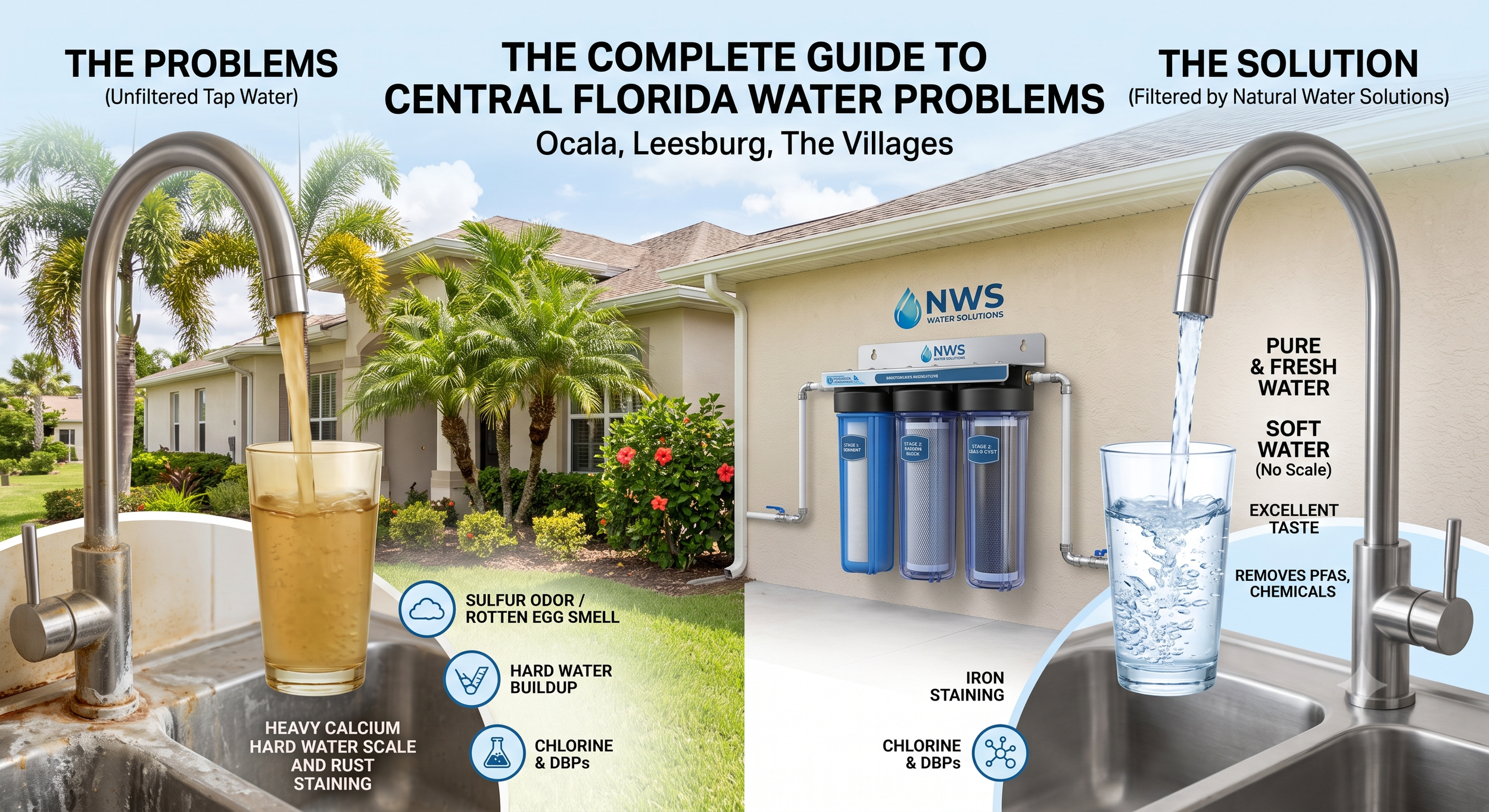
Whether you live in a historic home in Ocala
a lakefront property in Leesburg, or are enjoying retirement in The Villages, Central Florida offers an incredible quality of life. Unfortunately, the same cannot be said for our tap water.
If you have noticed a heavy chlorine taste in your drinking water, stubborn white scale buildup on your showerheads, or a "rotten egg" smell coming from your faucets, you are not alone. Central Florida's unique geology and aging municipal infrastructure create a perfect storm for poor water quality.
Here is a comprehensive breakdown of the most common water problems in Marion, Lake, and Sumter counties—what causes them, how they impact your home, and the modern science required to fix them.
Where Does Central Florida Water Come From?
To understand our water problems, you have to understand where the water originates. The vast majority of Central Florida’s tap water—whether you are on a private well or city water—is pumped from the Floridan Aquifer System(USGS).
This massive underground reservoir spans 100,000 square miles. However, the water sits entirely within deep limestone and dolomite rock formations. As groundwater slowly filters through this porous rock over decades, it acts like a sponge, absorbing high levels of minerals, gases, and organic matter before it ever reaches your municipal treatment plant or private well pump.
The Top 5 Water Problems in Ocala, Leesburg, and The Villages
1. Extreme Hard Water and Destructive Scaling
Because our aquifer is heavily composed of limestone, the groundwater absorbs massive amounts of calcium and magnesium. This creates "hard water," and Central Florida has some of the hardest water in the United States.
While calcium isn't a direct health threat, hard water is highly destructive to your home's plumbing.
Appliance Damage: Hard water creates scale buildup inside your water heater, drastically reducing its efficiency and lifespan. It also ruins the internal mechanisms of dishwashers and washing machines.
The Cost of Soap: Hard minerals prevent soap from lathering. You end up using twice as much laundry detergent and shampoo just to get clean.
Skin and Hair: The minerals leave a microscopic film on your body, leading to dry, itchy skin and brittle, dull hair.
2. The "Rotten Egg" Smell (Hydrogen Sulfide)
If you turn on the hot water and are immediately hit with a sulfur or "rotten egg" odor, you are dealing with hydrogen sulfide. This is a very common issue for homes on private well water throughout Marion and Lake counties.
Hydrogen sulfide gas is produced by naturally decaying organic matter deep underground. Aside from making your water completely unappealing to drink or bathe in, this gas is highly corrosive. Over time, untreated hydrogen sulfide will tarnish your silverware, eat away at copper plumbing, and leave dark black stains on your bathroom fixtures.
3. Heavy Chlorine and Harmful Disinfection Byproducts (DBPs)
For residents in The Villages and those on city water in Ocala and Leesburg, municipal treatment plants must use heavy doses of chlorine or chloramines to disinfect the water before pumping it miles through underground pipes to your home.
While chlorine is necessary to kill bacteria during transit, it leaves your tap water smelling and tasting like a public swimming pool. Even worse, when chlorine interacts with naturally occurring organic matter in the water, it creates chemical byproducts known as Trihalomethanes (THMs) and Haloacetic Acids (HAA9s). The Environmental Protection Agency (EPA) heavily regulates these disinfection byproducts because long-term exposure has been linked to severe health concerns.
4. Iron Staining and Mineral Buildup
Does your driveway, white vinyl fence, or shower basin have a distinctive orange, brown, or rust-colored stain? That is iron. Iron is naturally abundant in Central Florida’s soil and water.
When iron-rich water hits the air (such as coming out of a sprinkler head or your shower), it oxidizes. This oxidation creates stubborn rust stains that are nearly impossible to scrub away without relying on harsh, toxic chemicals.
5. Emerging Threats: PFAS ("Forever Chemicals") and Microplastics
Modern water concerns have evolved far beyond naturally occurring minerals. Today, synthetic chemicals like PFAS ("forever chemicals"), microplastics, heavy metals (like lead), and agricultural runoff are increasingly being detected in groundwater supplies nationwide.
Organizations like the Environmental Working Group (EWG) have mapped the spread of these forever chemicals across Florida. Standard refrigerator filters and basic carbon water pitchers are simply not equipped to remove these microscopic toxins.
Why Traditional Salt-Based Softeners Are Obsolete
For decades, the standard response to Florida’s water problems was a traditional ion-exchange water softener. However, this 1950s technology comes with significant drawbacks:
The Salt Hassle: Homeowners are forced to continuously buy and lug heavy 40-pound bags of salt from the hardware store.
Wasted Water: Traditional softeners must routinely "backwash" their resin beds, dumping hundreds of gallons of wastewater down the drain every week.
The "Slimy" Feel: Ion-exchange replaces calcium with sodium, leaving your skin feeling slippery, like you can never fully rinse the soap off.
Incomplete Filtration: A water softener only removes hardness. It does nothing to filter out chlorine, PFAS, heavy metals, or bacteria.
The Modern Solution for Central Florida Homes
Homeowners in Ocala, Leesburg, and The Villages are upgrading to smarter, cleaner technology.
At Natural Water Solutions, we provide medical-grade, whole-home filtration that addresses all of Central Florida's water issues simultaneously—without the hassle of salt bags.
Our advanced 3-chamber, 10-technology systems neutralize hard water scale physically rather than chemically using an advanced Physical Water Conditioner. They are engineered to remove up to 99.99% of contaminants, including chlorine, heavy metals, microplastics, and sulfur.
Best of all? The system is entirely maintenance-free.
No electricity required
No wasted water or backwashing
No heavy salt bags to carry
Once installed at your home's main water entry point, every tap, shower, and appliance receives purified water. The high-capacity cartridges easily last 3 to 5 years, providing you with true peace of mind.
You shouldn't have to tolerate bad water, deal with scale damage, or rely on expensive bottled water in your own home. Protect your appliances, your plumbing, and your family's health with a system designed specifically for Florida's unique water challenges.